Thursday, March 19, 2015

CIM now called OMF


                     140 Years of CIM, now called OMF

The China Inland Mission (CIM) was established by James Hudson Taylor on June 25, 1865. Eager to reach the inland provinces of China with the gospel, the mission prayed hard and sent out waves of workers to China throughout the late nineteenth century.
In 1900, a group of Chinese called the “Boxers” set out to
 exterminate all foreigners in China in a reign of terror during 
which hundreds of missionaries and Chinese Christians were put to 
death. The China Inland Mission (CIM) lost 79 people. Taylor died 
in 1905 after 50 years of active service for China, and D.E. Hoste, 
one of the Cambridge Seven, was appointed mission director.
Many missions pulled out in 1948-49, but the China Inland Mission

 (CIM) was one which attempted to stay. Having so decided, the 

China Inland Mission (CIM) took a further step of faith and 

brought in 49 new workers to Shanghai in 1948 and in 1949. It 

eventually became plain that the continued presence of the 

missionaries was causing suspicion and harassment for the Chinese 

believers. In 1950, the momentous decision was made that, in the 

best interests of the Chinese church, the China Inland Mission 

CIM) would withdraw. The mission began again in East Asia, 

establishing headquarters in Singapore.

A new name, Overseas Missionary Fellowship (OMF), was 
adopted in 1964 (changed again to OMF International in 1993) and 
the old name (China Inland Mission) was dropped. Asian 
Christians also began to be accepted into membership during this 
period, and home councils were formed in Japan, Korea, 
Singapore, Hong Kong, Malaysia, the Philippines, Taiwan and 
Indonesia. Today, nearly 20 percent of OMF International’s 
membership comes from Asia.
The nations of East Asia are still teeming with thousands who need 

to receive those “glad tidings” that Hudson Taylor sought to bring 

to the furthest points of China, and God is still leading. OMF 

International currently has nearly 3,000 staff, field workers and 

committed volunteers from 30 nations—1,400 of those are workers 

reaching out in East Asia. In 2015, a fellowship-wide celebration 

will take place to recognize God’s faithfulness to OMF 

International over the past 150 years.


OMF International is still breaking new ground in the most 
dramatically changing region of the world—whether in outreach to 
more than 100 people groups, working with disadvantaged 
children, seeking new ways of evangelizing the unreached of 
Manila, teaching and influencing students in Taiwan and 
Indonesia, pioneering a witness among the Malays in South 
Thailand, translating the Bible, or living as “salt and light” 
(Matthew 5:13-14) in countries closed to traditional missionary 
service. OMF International missionaries are giving their energies 
towards building a strong church in the countries of East Asia.

Friday, March 6, 2015

Hiroshima bomb - day that shook the World


                          Hiroshima Atomic Bomb Summary
Why USA decided to use the bombs on Japan: Japan’s stubborn refusal to surrender – would cost another million American military lives to attack Japan’s mainland. Japanese stubbornness is an extreme example of human willfulness (versus divine sovereignty).
Weather conditions in Japan would decide which Japanese city would be bombed – Hiroshima or Nagasaki – in this first atomic bomb. And weather is in God’s hands, assuredly a matter of divine sovereignty.
This first atomic bomb, called Little Boy, cost the US $2 billion to make. 100,000 Hiroshima inhabitants within a 3 Km radius from bomb center were killed.

The plane Enola Gay carried the bomb on board all the way to Japan, and was only “armed for dropping” by bomb expert Parsons some short time before reaching Hiroshima. Human error could have caused catastrophe on the plane itself. 

Coronation of Queen Elizabeth II


Monday, March 2, 2015

Grapes healthiest fruit

With a unique combination of crunchy texture and sweet, tart flavor, grapes have gained extreme popularity throughout the world. Grape is the second most popular fruit after oranges. It can be eaten as a refreshing snack as well as used in vegetable and fruit salads. It can be consumed in fresh or preserved form. It can be canned in jellies, crushed to prepare juices or wines and dried to prepare raisins. Grapes were introduced to America by the Spanish explorers approximately 300 years ago. Grape growing is one of the largest food industries in the world. Let's know some interesting facts about grapes.

General Facts:
There are more than 60 species and 8000 varieties of grapes all over the world. Some common varieties of grapes are blue, black, green, red, golden, blue-black, white and purple.
The main two types of grapes are European and American. They come in seedless and seeded varieties.
American grapes are available in September and October, while European grapes are available round the year.
The Thompson Seedless is the best selling grape in the USA. Golden raisins are prepared from these types of grapes.
The production of grapes is more than 72 million tons all over the world. There are approximately 25 million acres of grapes throughout the world.
It takes about 2½ pounds of grapes to produce a bottle of wine.
Grapes consist of about 80% of water, which make them a low-calorie snack or dessert. Raisins or dried grapes consist of about 15% of water.
Grapes contain flavonoids that give vibrant purple color to grapes, red wine and grape juice.
One grape cluster has on an average 75 grapes.
One grape vine can grow up to 50 feet long and can have about 40 clusters of grapes.
Eating too many grapes can give a laxative effect.
Fresh grapes can be stored in the refrigerator for about 2-3 days, when kept in a plastic bag or a covered container.

Tuesday, February 24, 2015

The World's Highest and Widest Falls

Angel Falls, Venezuela - Tallest
American bush pilot Jimmy Angel was gold prospecting when he found the waterfall now known as Angel Falls.  The waterfall, located in Gran Sabana, Venezuela, is the highest in the world.  They reach up to 3,212 feet at the highest point.  Just so you know, that is fifteen times higher than Niagara Falls.  The falls plummet from the Auyan Pepuy, a strange, primordial plateau of sandstone.  These are contained in Canaima National Park.  Sir Arthur Conan Doyle’s masterpiece: The Lost World was inspired here.  The park has a hotel which is very expensive.  Here, a flight is your best bet to see the amazing sight.  The best time for hiking the surrounding area and the park is from October to May.  The best time for navigating the rivers stemming from the waterfall is from May to December.  During the dry season (January to May) the waterfall is unobstructed, but very thin.  During the wet season from (June to December) the waterfall is giant, but often enveloped with clouds.

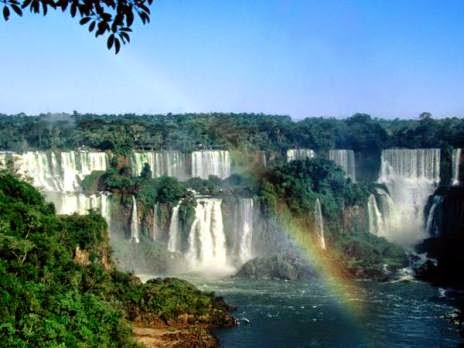
A rainbow over a section of Iguazu Falls, Widest
Iguazu Falls in Misiones, Argentina may not be as well-known as the Niagara Falls, however, they are bigger than the North American cataract.  Around 1,700 cubic meters of water plunge headlong into the tumultuous rapids below over the 200 foot fall.  There are over 275 smaller falls, over the 3 in Niagara.  Some of these stretch over 2 miles!  The falls can be seen from both Brazil and Argentina.  There is a great number of walkways and catwalks that can be meandered through dense rainforest jungle.  The Hotel des Cataratas is located right on the falls and costs $165.  It may be a bid difficult to fall asleep amongst the thundering waters nearby.  Like with Angel Falls, the best time for hiking the surrounding area and the park is from October to May.  The best time for navigating the rivers stemming from the waterfall is from May to December.  During the dry season (January to May) the waterfall is unobstructed, but very thin.  During the wet season from (June to December) the waterfall is giant, but often enveloped with clouds.